Date:2023-09-01
The “Safety Code” for Dangerous Goods Transport
In the global supply chain, dangerous goods transport is an indispensable yet high-risk link—according to the International Maritime Organization (IMO), over 1 billion tons of dangerous goods are transported cross-border annually, covering more than 3,000 categories such as highly toxic chemicals, flammable liquids, and corrosive substances. Packaging failure can lead to cargo leakage and logistics disruptions at best, and catastrophic accidents like explosions, poisoning, and environmental pollution at worst.
To unify global safety standards for dangerous goods packaging, the United Nations Recommendations on the Transport of Dangerous Goods, Model Regulations (hereafter “UN Model Regulations”) established the “UN packaging mark” system, with container categories X, Y, Z as core identifiers. These categories correspond to different protection levels and directly determine whether packaging can match the hazard level of the cargo. However, many foreign trade, chemical, and logistics enterprises are unclear about the differences between these categories, often facing customs detention, fines, or even safety hazards due to “packaging level mismatch.” This article systematically explains the specific meanings, application scenarios, and compliance requirements of X/Y/Z categories to help enterprises build a safe line of defense for international transport.
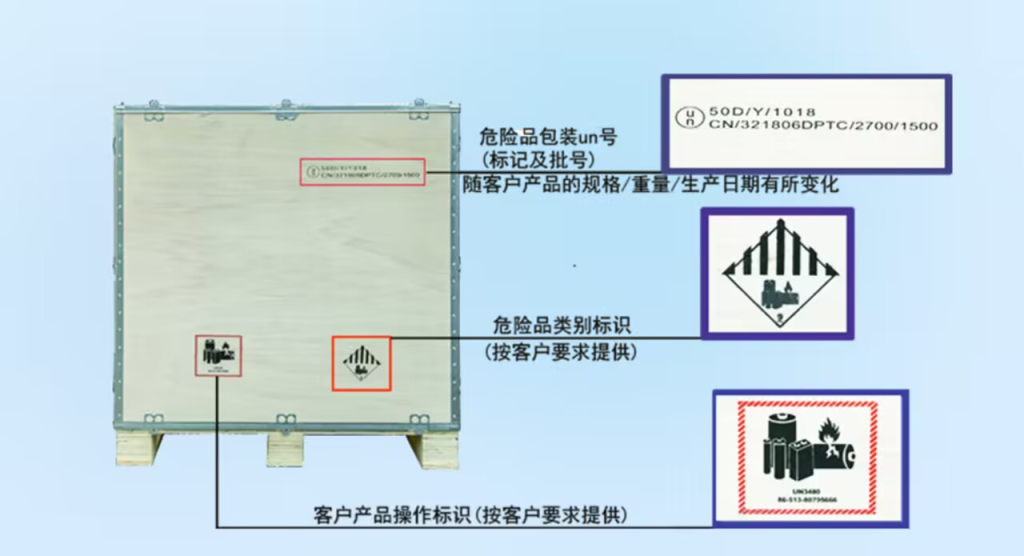
UN packaging marks are not a single label but a comprehensive coding system that includes “packaging type, protection level, performance parameters, and production information.” They have been incorporated into national regulations by over 190 countries (e.g., China’s General Technical Conditions for Transport Packages of Dangerous Goods GB190, US DOT regulations, EU ADR agreement).
Any packaging used for cross-border transport of dangerous goods must bear a complete UN mark—missing or incorrect marks will directly result in cargo detention by the destination country’s customs, or even inclusion in the “high-risk transport entity” list. Container categories X/Y/Z are the core indicators of packaging protection capability in this system, with the logic that “the higher the cargo hazard level, the stricter the packaging protection requirements.”
Category X is the highest protection level of UN packaging, corresponding to Type I packaging. It applies to dangerous goods with “extremely high hazards that would cause severe personal injury or environmental damage if leaked.”
Category X packaging is standard for highly toxic, highly corrosive, and highly reactive goods. Typical examples include:
Highly toxic chemicals: Sodium cyanide, arsenic trioxide (arsenic);
Highly corrosive substances: Anhydrous hydrofluoric acid (corrodes glass), fuming sulfuric acid;
Explosives (low dose): Small detonators, explosive intermediates;
Highly flammable gases: Liquid acetylene, compressed hydrogen.
Take sodium cyanide exported by a large chemical foreign trade enterprise as an example: the oral median lethal dose (LD50) of this cargo is only 6mg/kg (0.1g can be fatal to adults), so Category X packaging is mandatory. If a lower-level package is misused, leakage would not only cause poisoning of exposed personnel but also contaminate soil and water sources, triggering a regional environmental crisis.
Category X packaging must pass the strictest safety tests in the UN Model Regulations, with core items including:
Drop test: Drop height is set according to package weight, e.g.:
Package weight ≤10kg: Drop height 1.8m (equivalent to falling from an adult’s head height);
10kg < weight ≤25kg: Drop height 1.5m;
25kg < weight ≤50kg: Drop height 1.2m;
Hydraulic test: The package must withstand an internal pressure of no less than 250kPa (about 2.5 times normal atmospheric pressure) for 5 minutes without leakage;
Leakage test: The package is immersed in water for 24 hours without any liquid seepage;
Stacking test: The package must withstand stacking weight equivalent to a 9m height (about 3 container layers) for 24 hours without deformation.
Only packages that pass all tests can be marked with “X”—this is why Category X packaging costs 2-3 times more than Category Y, but it is a “must-have” for high-risk cargo transport.
Category Y is the medium protection level of UN packaging, corresponding to Type II packaging. It applies to dangerous goods with “medium hazards that would cause local harm if leaked, but the impact range is controllable.”
Category Y packaging is one of the most widely used categories in foreign trade transport. Typical applicable goods include:
Flammable liquids: Solvent gasoline with a flash point of 45°C, paint thinner;
Medium-toxic chemicals: Pesticide dimethoate, rust remover oxalic acid;
Oxidizing substances: Low-concentration potassium permanganate, 30% hydrogen peroxide.
For example, solvent gasoline (flash point 42°C) carried by a logistics enterprise is a Type II dangerous good: leakage would cause a local fire but not a large-scale explosion or toxic pollution. Therefore, Category Y packaging meets safety requirements—avoiding the high cost of Category X packaging while passing compliance inspections.
The testing standards for Category Y packaging are slightly lower than Category X but still meet basic safety requirements:
Drop test: Drop height 1.2m for packages ≤10kg, 1.0m for packages over 10kg;
Hydraulic test: Withstand an internal pressure of no less than 150kPa for 5 minutes without leakage;
Stacking test: Withstand stacking weight equivalent to a 6m height for 24 hours without deformation.
Category Z is the minimum protection level of UN packaging, corresponding to Type III packaging. It applies to dangerous goods with “low hazards that would cause only minor harm if leaked.”
Category Z packaging mainly adapts to low-risk dangerous goods. Typical examples include:
Low-toxic chemicals: Boric acid (oral LD50 >5000mg/kg), citric acid (weakly corrosive);
Non-flammable liquids: Antifreeze (ethylene glycol concentration ≤30%), some lubricating oils;
Solid dangerous goods: Low-toxic pesticide granules, slightly corrosive ceramic cleaners.
For example, low-toxic boric acid additives exported by a light industry enterprise are Type III dangerous goods: their toxicity is only 1/5 that of table salt, and simple cleaning is sufficient after leakage. Therefore, Category Z packaging meets compliance requirements while significantly reducing packaging and transport costs.
The testing standards for Category Z packaging are the most basic in the UN system:
Drop test: Drop height 0.6m for packages ≤10kg, 0.5m for packages over 10kg;
Hydraulic test: Withstand an internal pressure of no less than 100kPa for 5 minutes without leakage;
Stacking test: Withstand stacking weight equivalent to a 3m height for 24 hours without deformation.
For enterprises, choosing the wrong packaging category can lead to compliance issues, cost waste, or safety hazards. The core steps for category selection are as follows:
Step 1: Determine the Hazard Category of the Cargo
First, clarify the cargo’s hazard class (e.g., Class 6.1 highly toxic substances, Class 3 flammable liquids) according to the Dangerous Goods List (GB12268) or UN dangerous goods number.
Step 2: Match the Corresponding Packaging Category
Refer to the “Packaging Category Allocation Table” in the UN Model Regulations:
Class 1 explosives (Items 1.1-1.3), Class 6.1 highly toxic substances: Must choose Category X;
Class 3 flammable liquids (flash point <23°C), Class 8 strong corrosive substances: Choose Category X/Y;
Class 3 flammable liquids (flash point >60°C), Class 9 miscellaneous dangerous goods: Choose Category Y/Z.
Step 3: Verify Packaging Compliance
When selecting packaging, check:
The package bears a complete UN mark (including X/Y/Z identifier);
The packaging supplier provides a UN Packaging Performance Inspection Report (valid for 5 years);
The actual load capacity and volume of the package match cargo requirements.
Step 4: Retain Compliance Documents
Before transport, retain the “packaging performance report” and “cargo hazard characteristic identification report” for inspection by customs and transport parties.
Ignoring the compliance of UN packaging categories can lead to severe consequences:
Compliance Penalties: In 2024, a Zhejiang foreign trade enterprise was detained by EU customs and fined €120,000 for transporting Category Y flammable liquids in Category Z packaging. It was also restricted from transporting dangerous goods to the EU for 6 months;
Safety Accidents: In 2023, a logistics enterprise misused Category Y packaging to transport Category X sodium cyanide. 2kg of cargo leaked due to packaging damage during transit, causing mild poisoning in 3 loaders. Direct economic losses exceeded ¥500,000, and it was investigated by the local emergency management department.
These cases confirm that UN packaging categories are not “formal labels” but the “lifeline” of dangerous goods transport safety.
As global attention to dangerous goods transport safety increases, testing standards for UN packaging categories are gradually tightening:
The EU’s new Dangerous Goods Transport Regulation (effective 2025) stipulates that the drop test height for Category X packaging will increase by 10% (e.g., the drop height for packages ≤10kg will rise from 1.8m to 1.98m);
The 2024 version of China’s Inspection Regulations for Transport Packages of Dangerous Goods requires Category Y/Z packaging to add a “low-temperature impact test” (simulating cold zone transport environments).
For enterprises, it is necessary to establish a “packaging compliance management system”: regularly train logistics and foreign trade personnel, cooperate with suppliers qualified to produce UN packaging, and track updates to national regulations to avoid falling into the passive situation of “compliance lag.”
Conclusion: Safeguarding Global Supply Chain Safety with Compliance Protection
UN packaging container categories X/Y/Z are the balance scales of “safety and efficiency” in dangerous goods transport: X is the “safety armor” for high-risk cargo, Y is the “balanced choice” for medium risk, and Z is the “basic protection” for low-risk cargo. For enterprises, accurately understanding and applying these identifiers is not only a compliance requirement for cross-border transport but also a responsibility for personnel safety and environmental security.
In today’s increasingly connected global supply chain, only by building a solid line of defense for packaging safety can dangerous goods transport truly become a “safe link”—this is the core value of the UN packaging mark system.
Telephone
Copyright @ 2026 SHANGHAI JINGTIAN GONGSI No:84506